Halden: A concept back office where the agent asks first
Halden is a concept: the back office for a coffee roaster in Portland with six cafes and a wholesale line. Sales, stock, staff and payments sit in one place, and an agent drafts the next action and waits for the owner to approve it. There is no client behind it. I set the brief, directed an AI coding agent to build it, and reviewed every screen. The data is made up.
01The brief
Six cafes, one back office, and an owner who reads it every morning.
A business with several cafes runs on a point-of-sale back office. The owner opens it in the morning to see yesterday's sales, what is running low and who is on shift. I started from the structure of Square's web dashboard, because many cafe owners already know it.
02The problem
A dashboard shows what happened. The owner has to work out why.
When Alberta Arts sells 18% less on a Tuesday, the answer sits in three places: the shift log, the stock count and the item sales. The owner opens each one, puts them together and then decides what to order or who to schedule. That is three screens and a guess before anything gets fixed.
03Solution
An agent reads the same data and drafts the next step.
The agent explains what happened, shows where each claim comes from, and turns its fix into an action the owner approves, edits or rejects. The clips are recorded from the running app.
Every claim shows its evidence.
Each claim in the answer ends with a numbered source. Hovering it opens the source itself: the morning of the shift log, the oat milk running out on a curve, oat drink sales for the last six Tuesdays. The owner checks the agent without leaving the thread.
The owner edits before approving.
The fix arrives as a card with the supplier, the cost, the arrival time and the reorder rule it would also save. Edit turns the quantity into a stepper and the cost follows it. Nothing is ordered until the owner presses Approve, and the thread keeps the record.
A cafe opens in place.
A location on the home screen opens a drawer instead of a new page: sales for the week, who is on shift, what is running low, and anything the agent is waiting on there. Closing it returns to the same spot.
The schedule draft explains itself.
The agent's second action is next week's schedule. The shifts it added are outlined, and each one says why it is there on hover. Publishing sends the week to the team.
04Build
One evening with a coding agent, then a review of every screen.
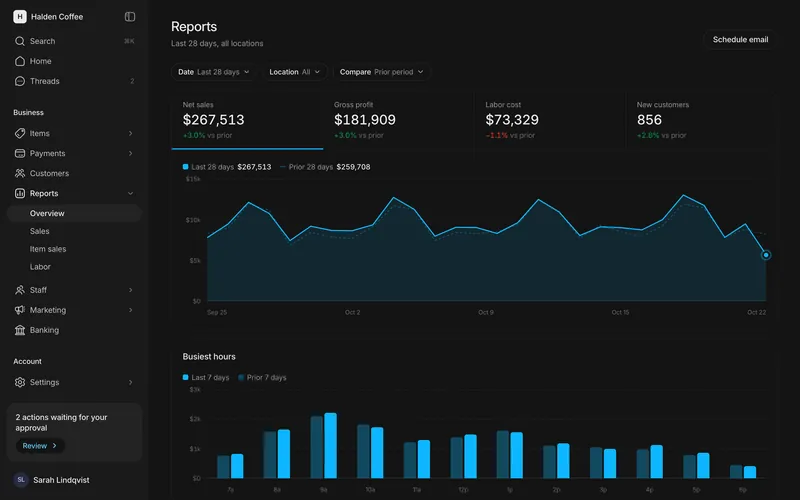
An AI coding agent built Halden from my brief in Vite and plain JavaScript. The page structure follows Square's web dashboard. The tokens and components come from Sana, renamed. The constraints were mine: a US business, US dollars, 12-hour time, and no editors or builders, only dashboards and lists. 25 screens, each with default, empty, loading and error states, plus a dark theme.
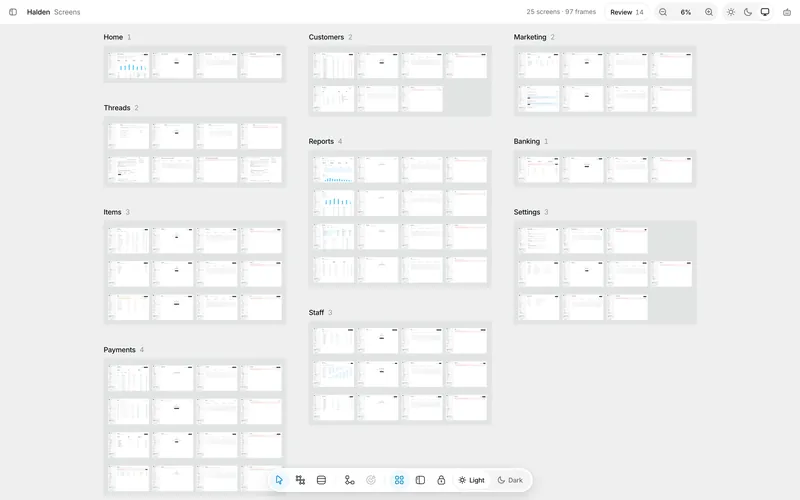
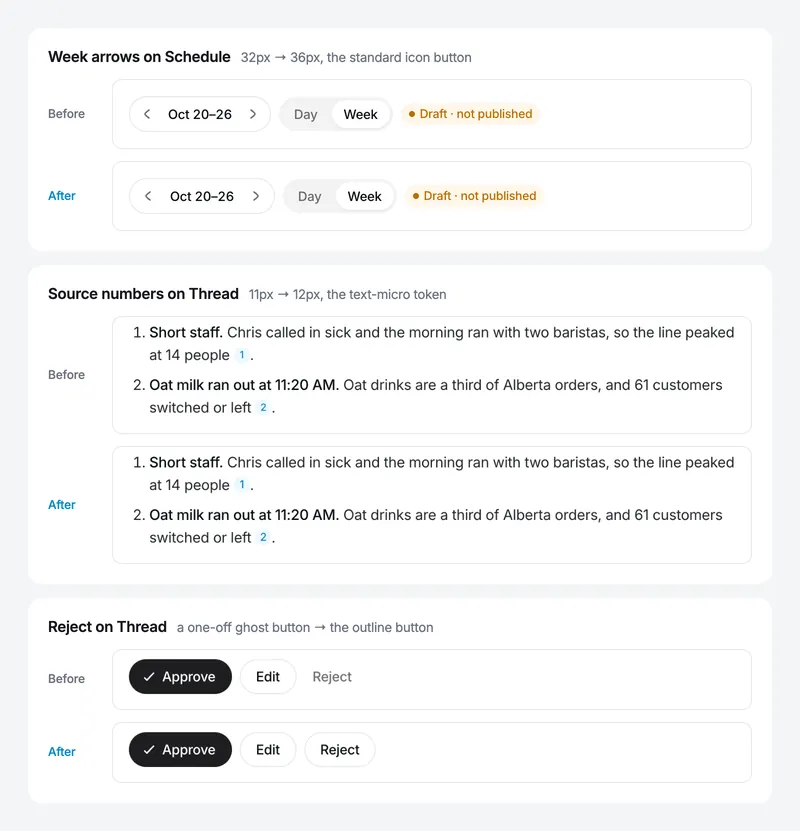
Then I reviewed it with screen canvas, a tool I built to check every screen and state at once. It found 21 button variants across 450 buttons and asked 14 questions. Three answers became fixes the agent made: icon buttons on Schedule that were 4px too short, an 11px source label with no token behind it, and a Reject button styled like nothing else. The full story is in A canvas for reviewing AI-built UI.
05Limits
No cafe owner has used it yet.
The numbers are invented, and the agent's answers are written into the prototype, not generated. The next step would be to put the thread and the approval card in front of two or three owners and see what they approve without reading.
Working on something similar?
Halden was built by an agent in one evening. A Consistency Review checks a product like this one.